
Hot yoga vs Pilates comes down to your main goal. Original Hot 26&2 yoga burns more energy per class, so it suits weight loss, flexibility and stress. Pilates isolates the deep core, so it suits rehab and posture. For men, hot yoga usually covers more, because it adds heat, leg strength and stretching that most gym routines skip.

That's the short answer to hot yoga vs Pilates. The rest of this guide shows the evidence behind it, what each method does to your core, and how men in particular should choose. It is written from a teacher's standpoint, by the YogaFX team in Bali, and checked against the research we can actually open and read.
Hot Yoga vs Pilates: The Verdict by Goal
Most people weighing hot yoga vs Pilates want one thing first. So start with the goal, not the method. If you pick by goal, the choice is usually clear within a minute.
- Weight loss and calorie burn. Hot yoga. A 90-minute class asks your heart to work hard for the whole session, and the heat adds load.
- Deep core and pelvic floor. Pilates. Its whole system is built around slow, isolated trunk control.
- Flexibility. Hot yoga. Warm tissue stretches more easily, and every class works the spine in every direction.
- Back pain rehab. Pilates, at least at first. It is low impact and has the stronger rehab evidence.
- Stress and mood. Hot yoga. It has a randomised trial on depression behind it, which Pilates does not.
In other words, neither one wins everything. Instead, each one wins a different category. That's why the most honest answer to "is hot yoga better than Pilates?" is another question: better for what? The table below sums up hot yoga vs Pilates in seven rows.
| Factor | Original Hot 26&2 yoga | Pilates (mat or reformer) |
|---|---|---|
| Room | 40°C, 40% humidity | Usually room temperature |
| Class length | 90 minutes, fixed | Usually 45 to 60 minutes |
| Structure | Same 26 postures and 2 breathing exercises every class | Varies by teacher and equipment |
| Calories (measured) | About 460 kcal men, 330 kcal women per class | Lower intensity; no comparable heated-class data |
| Main core effect | Standing balance and back strength | Deep stabilisers, slow control |
| Best evidence | Strength, flexibility, mood | Chronic low back pain |
| Main caution | Heat, hydration, heart conditions | Form needs a skilled teacher |
Hot Yoga vs Pilates: What the Research Says
A fair hot yoga vs Pilates comparison needs numbers, not opinions. So here is what the studies measured, with the source for each one. Where a page blocked us from reading it, we name the study instead of linking it.
Calorie burn in a heated class
Researchers at Colorado State University measured experienced practitioners during a real 90-minute class. As their university summary reports, men burned about 460 calories and women about 330. Heart rate averaged about 160 beats per minute.
That's solid work for a stretching class. However, it isn't a sprint session. It sits roughly where a brisk, long walk sits for many people. So on weight loss, hot yoga vs Pilates is a win for hot yoga through steady volume, not through extreme burn. For the full picture, read our guide to what the research says about Bikram for weight loss.
Strength and flexibility
An 8-week trial by Tracy and Hart (2013) put 10 adults through 24 heated classes and compared them with 11 controls. The yoga group gained isometric deadlift strength, much better lower back and hamstring flexibility, and lost a little body fat.
One result matters for an honest comparison, though. Maximal oxygen uptake did not change. In other words, hot yoga raised the heart rate but did not improve aerobic fitness in that trial. If cardio fitness is your main goal, the hot yoga vs Pilates question matters less than adding running, cycling or swimming to either practice.
Pilates and back pain
For Pilates, the best evidence is on chronic low back pain. A Cochrane review pooled 10 trials with 478 patients. According to the American Family Physician summary, Pilates taught by certified instructors improved pain compared with minimal treatment.
That said, the same review could not show that Pilates beats other exercise. The effects were modest and the evidence quality was low to moderate. So Pilates is a good rehab choice, but it isn't magic. On back pain, hot yoga vs Pilates leans toward Pilates for the early weeks.
Mood and depression
Here hot yoga has the clearer data. In a randomised trial from Massachusetts General Hospital (Nyer et al., 2023, PubMed 37883245), 59% of the heated yoga group cut their depression symptoms by half or more in 8 weeks, versus 6% on the waitlist. Harvard Health covered the study, which enrolled 65 adults.
We know of no Pilates trial with that design on depression, which is the biggest evidence gap in the hot yoga vs Pilates debate. That doesn't mean Pilates cannot help mood. It means the evidence is thinner. If you live with depression, talk to your doctor before you start either practice.
460 / 330 kcal
Hot yoga calorie burn
Men and women per 90-minute class (Colorado State University).
80% vs 72%
Heart rate, men vs women
Average share of predicted maximum in class (ACE research).
59% vs 6%
Depression response
Heated yoga vs waitlist after 8 weeks (Nyer et al. 2023).
10 trials
Pilates for back pain
478 patients; modest pain relief (Cochrane review, 2015).
Hot Yoga vs Pilates for Core Strength
Both methods train the core, but not in the same way. Pilates works from the inside out. It asks for slow, precise control of the deep muscles that hold the spine, such as the transverse abdominis and multifidus. That is its signature, and it does it very well.
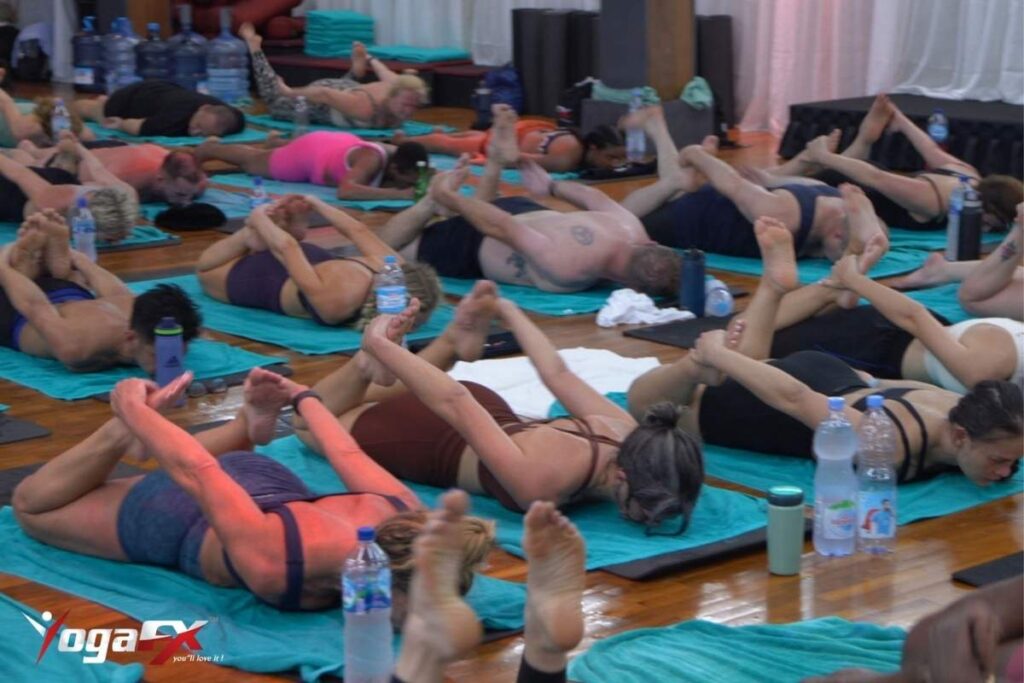
Hot yoga works the core through standing balance. In Dandayamana Janushirasana (Standing Head to Knee) you hold your whole body still on one leg, with the abdomen locked. In Balancing Stick the trunk and legs form one straight line. As a result, the core learns to work with the legs, not on its own.
So which one wins hot yoga vs Pilates for the core? It depends on the job. For pelvic floor work, postnatal recovery or a weak lower back, Pilates is the more precise tool. For a core that holds you steady while you lift, run or play sport, the standing series is the more complete one. Our Standing Head to Knee guide shows how much trunk work one posture asks for.
One of our trainees summed up the floor series in a graduation poem. "We have learned too quickly to get down on the floor and use our sit-ups to develop our core," said Fiona, in our YouTube review, 2024. The sit-ups between floor postures come back again and again in every class.
Yoga or Pilates for Men?
Men ask this a lot, and often for the same reasons. They are tight in the hamstrings and hips, they lift or sit all day, and they want something that feels like real work. So what is better for men, yoga or Pilates? In the hot yoga vs Pilates decision, for most men we teach, hot yoga is the better first choice.
Why hot yoga suits most men
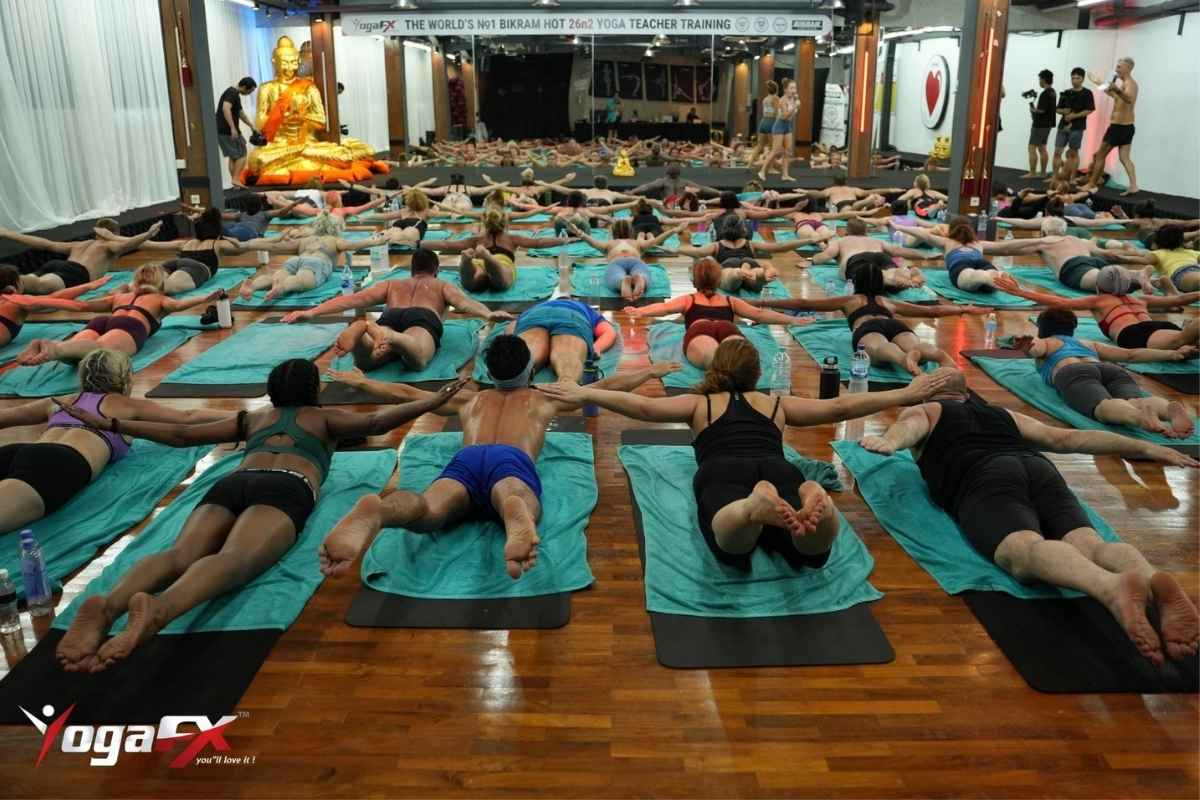
Here's why. First, men in the Colorado State work burned about 460 calories per class, more than the women did. Second, the heat helps the tight tissue that most men bring to their first class. Third, the standing series loads the legs and back for most of the first half of class, which many men find more satisfying than mat work.
There's one caution that men should take seriously. In research sponsored by the American Council on Exercise, men averaged about 80% of predicted maximum heart rate versus 72% for women. Men also ran hotter, with an average peak core temperature of 103.2°F. So drink before class, rest when you need to, and never treat the heat as a contest.
When Pilates is the better pick for men
Pilates still has a place for men, of course. It was created by a man, Joseph Pilates, and it is excellent for lifters with a weak trunk or a nagging back. If you are coming back from injury, start with Pilates. Then add hot yoga once you are pain free.
| If you are a man who... | Start with | Why |
|---|---|---|
| Lifts weights and feels stiff | Hot yoga | Heat plus long holds open the hips and hamstrings |
| Wants to lose weight | Hot yoga | About 460 kcal per class for men in the CSU data |
| Has chronic low back pain | Pilates first | Best rehab evidence; then add hot yoga |
| Runs or cycles | Hot yoga | Leg and back strength, plus flexibility runners lack |
| Has a heart condition | Pilates, after medical advice | Lower heat and heart rate demand |
| Wants both | 3 hot classes plus 1 Pilates | Covers flexibility, strength and deep core |
We see this hot yoga vs Pilates pattern at the studio often. Ani came to our teacher training as a bodybuilder, expecting to be the strongest in the room. In our YouTube review, 2026, Ani said the course left them "more fit, more stronger" and that the other trainees turned out stronger than expected.
For a deeper look at what changes in a man's body over months of practice, see our guide to hot yoga body transformation for men.
Hot Yoga vs Hot Pilates
Many city studios now sell hot Pilates too, which adds a third option to the hot yoga vs Pilates choice. So which hot class should you book? The difference is in why the room is hot.
In the Original Hot 26&2 method, the heat is part of the design. The room is set to 40°C with 40% humidity, and the sequence was built for that room. The studies above were run in classes like that, too. In hot Pilates, the heat is an add-on. Temperatures vary from studio to studio, and the Pilates moves work the same without it. If you are weighing a flowing hot class instead, see our hot vinyasa vs Bikram comparison.
- Ask the temperature. A studio should tell you the room settings before you book.
- Ask about the sequence. A fixed sequence lets you track progress class by class.
- Ask about the teacher. Heat makes good teaching more important, not less.
Keep in mind that sweat is not a measure of results. Heavy sweating cools you down. It does not clear toxins, and the weight you lose in class is mostly water that comes back when you drink.
Back Pain, Flexibility and Body Shape
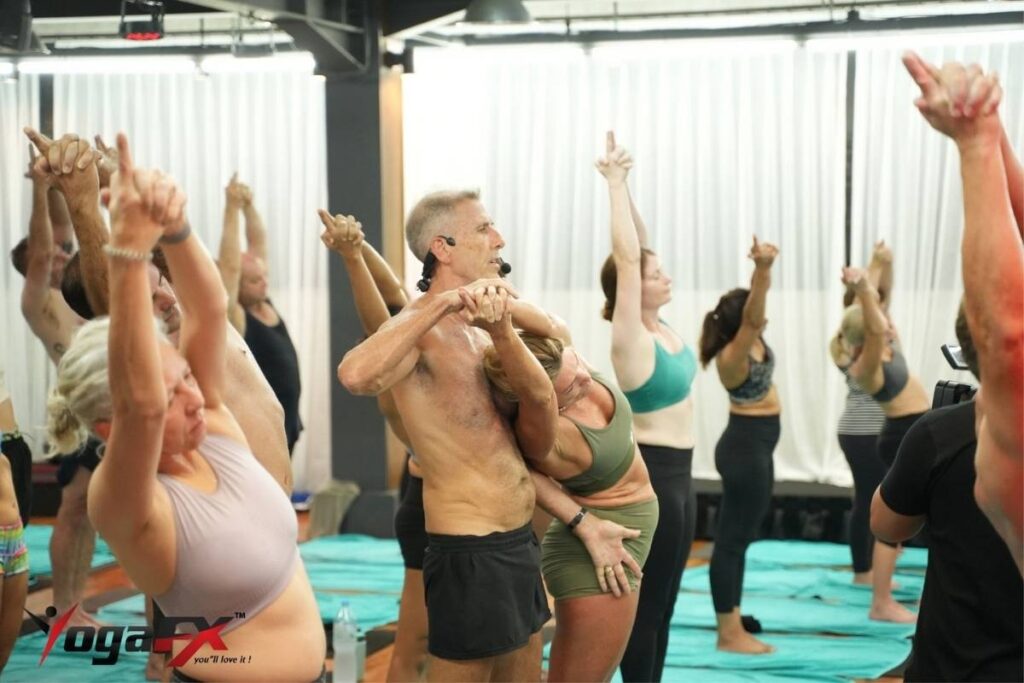
Back pain is where the hot yoga vs Pilates choice needs the most care. Pilates suits acute pain, disc problems and the weeks after surgery, because it is gentle and easy to scale. Hot yoga suits the stiff, sitting-all-day kind of back, because every class moves the spine forward, back, sideways and in a twist.
For example, Half Moon bends the spine sideways, Camel and Cobra bend it back, and Spine Twist rotates it. That full range in every class is rare. Our guide to Bikram yoga for lower back pain and sciatica goes posture by posture. With any back condition, consult a healthcare professional first.
For flexibility, hot yoga vs Pilates is a clear win for the heat in most students. The Tracy and Hart trial showed large lower back and hamstring gains in only 8 weeks. Pilates improves flexibility too, but slowly, because it lengthens muscles under control rather than in warm, long holds.
Body shape changes differ as well. Hot yoga tends to make people leaner, with stronger legs, because of the steady calorie use and the standing work. Pilates tends to improve posture and the look of the midsection. Neither one spot reduces fat. That only comes from overall energy balance, sleep and diet.
How to Combine Both in One Week
You don't have to settle hot yoga vs Pilates forever. Because the two methods train different things, they fit together well. Here is a simple week that many of our students follow.
- Monday, Wednesday, Friday: a 90-minute hot yoga class for strength, flexibility and stress relief.
- Tuesday or Thursday: one Pilates session for deep core and posture.
- Weekend: a walk, a swim or a full rest day.
After about 8 weeks, students often tell us two things. Their balance postures get steadier from the Pilates work, and their Pilates range improves from the heat.
Beginners on either side of hot yoga vs Pilates can start tomorrow. Hot yoga is easy to follow, because the teacher talks you through every posture with a set dialogue. The hard part is the heat in the first 5 to 10 classes. Pilates is easy on the body, but form matters a lot, so a good teacher is essential.
The Bikram Background: Where Each Method Came From
The two methods grew up in very different places. Pilates began in the early 1900s as Joseph Pilates' system of controlled exercise, later used by dancers to train and recover. The hot 26&2 sequence came from India and spread worldwide in the 1970s and 1980s as Bikram yoga.
Today many teachers use the name Original Hot 26&2 yoga for the same sequence. The postures, the heat and the dialogue are unchanged. That's why "Bikram Pilates" searches often land on comparisons like this one: people want to know how the classic hot sequence stacks up against the classic core method.
Learn the Method with Mr. Ian at YogaFX Bali
Mr. Ian Terry, E-RYT 500 and founder of YogaFX, has taught more than 12,000 hours and trained 1,500+ graduates from over 80 countries. He trained for five years, from 2014 to 2019, with the founder of the Bikram Hot 26&2 method. He is also a Master Trainer for the Republic of Indonesia Yogasana Sports Federation.
In Mr. Ian's classes and trainings, the dialogue is taught word for word. That matters for this comparison, because a fixed script and a fixed room are what make hot yoga results easy to track, class after class. So in hot yoga vs Pilates, Pilates can sit alongside it as a partner, not a rival.
Our Bali studios in Seminyak and Canggu run the 90-minute class in natural tropical heat, with no electric heaters. If you want to teach the method, the Bikram Hot 26&2 Yoga Teacher Training MasterClass is a 6-day hybrid course: online study first, then an intensive in Bali.
- Next intake: check-in Sunday 24 January 2027, check-out Friday 29 January 2027.
- Certification: Yoga Alliance RYT 200-Hour plus Bikram Hot 26&2 200-Hour International Yoga Certification.
- Price: US$1,899 Early Bird, with interest-free payment plans from US$250 per month.
Compare the formats in our guide to Bikram yoga teacher training, six days vs nine weeks, or message Mr. Ian on WhatsApp to ask about your own goals.
FAQ
Is hot yoga better than Pilates?
In hot yoga vs Pilates, hot yoga is better for calorie burn, flexibility and mood, with a randomised trial showing 59% of participants halved their depression symptoms in 8 weeks. Pilates is better for deep core control and back pain rehab, where a Cochrane review found modest benefits. Neither is better for everything, so choose by your main goal.
What is better for men, yoga or Pilates?
For most men, hot yoga is the better first choice. Men burned about 460 calories per 90-minute class in Colorado State research, and the heat helps tight hips and hamstrings. Pilates suits men with a weak trunk or chronic back pain. Many men do three hot classes and one Pilates session each week.
Does hot yoga or Pilates burn more calories?
In a typical class, hot yoga burns more. Colorado State researchers measured about 460 calories for men and 330 for women in a 90-minute heated class. Pilates classes are usually shorter and lower in intensity. Remember that sweat is mostly water, so the scale drop after class is not fat loss.
Which is harder, hot yoga or Pilates?
They are hard in different ways. Hot yoga is harder on the heart and on heat tolerance, with men averaging about 80% of maximum heart rate in ACE research. Pilates is harder on precision and slow muscle control. Most beginners find their first hot class tougher, mainly because of the 40°C room.
What's the difference between hot Pilates and hot yoga?
In Original Hot 26&2 yoga, the heat is part of the method: 40°C and 40% humidity for a fixed 90-minute sequence. In hot Pilates, the heat is added to moves that work without it, and temperatures vary by studio. Most of the published heated-class research was done on the 26&2 format.
Can you do yoga and Pilates together?
Yes, and they combine well because they train different things. A simple plan is three 90-minute hot yoga classes and one Pilates session per week, with one rest day. The heat builds flexibility and leg strength, while Pilates sharpens deep core control. Check with a doctor first if you have a heart condition.
Still have questions? Message Mr. Ian and the YogaFX team on WhatsApp and we will answer them personally. Tell us your goal, your schedule and any injuries, and we will help you decide between hot yoga vs Pilates, or how to combine them.