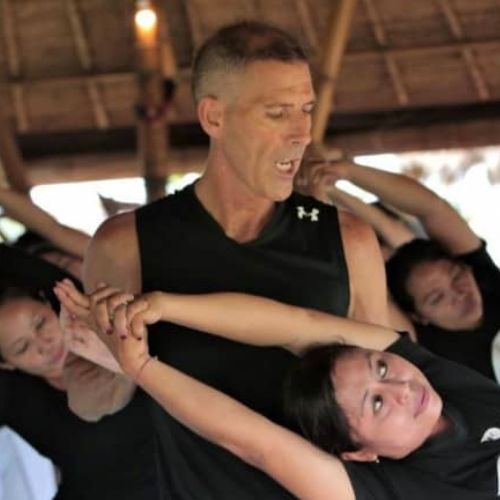
Competitive yoga is the performance of yoga postures in sporting competitions, where judges score athletes on form, balance and control. It is also called yogasana sport. It runs from school events in India to world championships, and it grows from the same postural tradition as the Bikram 26&2 sequence.

This guide explains how competitive yoga works in plain language. You will see the events, the age groups, the bodies that run the sport and the main arguments against it. Mr. Ian Terry, E-RYT 500 and a Master Trainer of the Republic of Indonesia Yogasana Sports Federation, adds what he sees from both the studio and the competition floor.
Competitive Yoga at a Glance: Five Numbers
If you want the short version first, here it is. Competitive yoga is a young sport with a fast-growing field, and the 2026 world championship in Ahmedabad gives us the clearest numbers so far. Each card below comes from a named source.
What Competitive Yoga Is, and What It Is Not
The simple definition
The simplest definition comes from the reference work on the subject. Wikipedia describes it as the performance of asanas in sporting competitions, and it notes the idea is controversial because some practitioners feel it conflicts with the nature of yoga. Both statements are fair, so you can hold both in your head at once.
In practice, competitive yoga looks like gymnastics without the apparatus. An athlete walks onto a mat, performs set postures, and a panel scores the result. Judges care about alignment, stability and control. Nobody scores your breathing, your mood or your spiritual progress, because a panel cannot measure those things.
That's the first thing to understand, because it explains most of the arguments. Competitive yoga tests the physical side of the practice, which is the asana limb, and the Indian name yogasana says the same thing. It does not claim to test the rest. Some federations, such as the International Federation of Sports Yoga, say their championships cover all eight limbs of yoga. Most national yogasana bodies focus on posture performance.
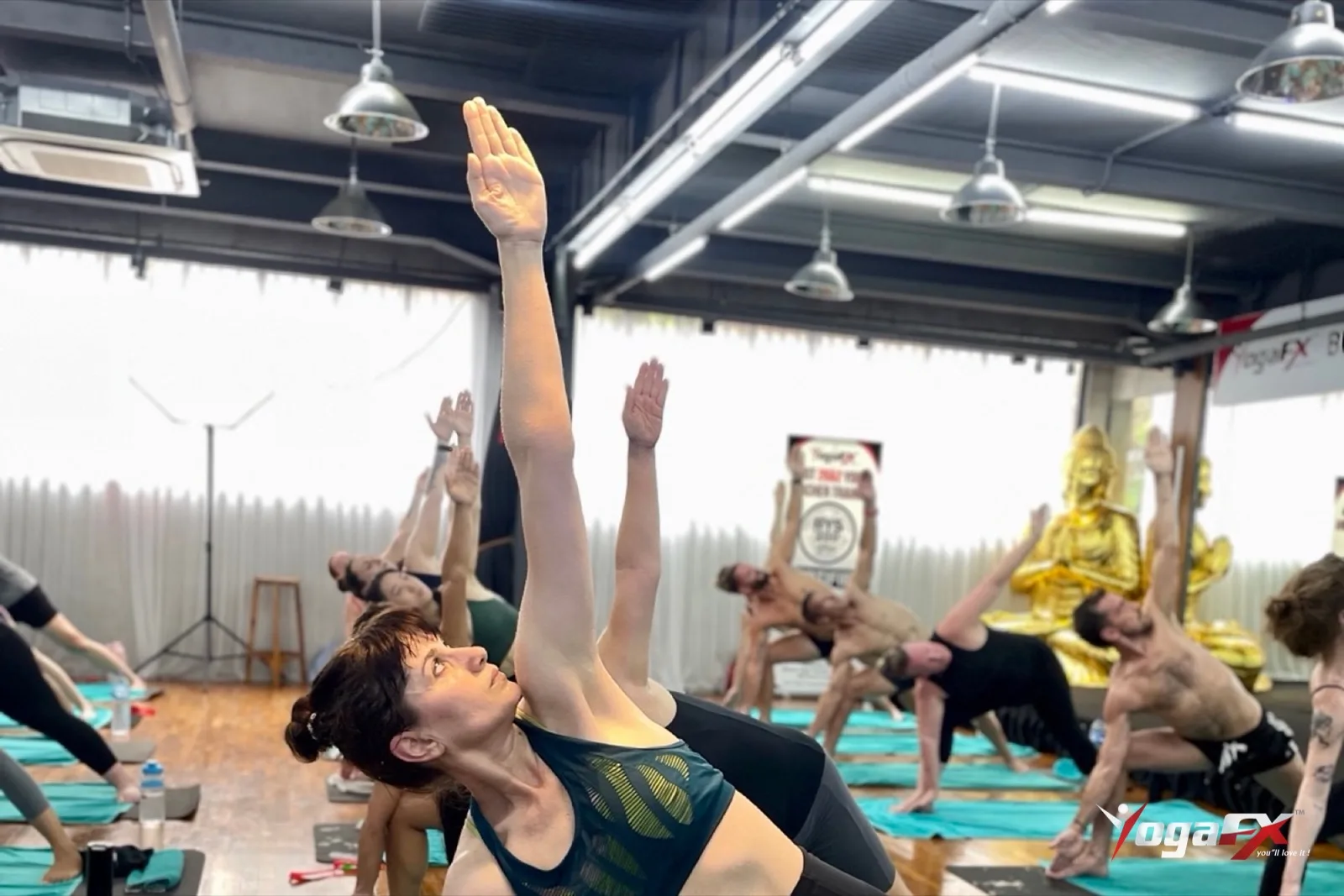
It is also not the same as a studio class. In a normal class nobody ranks you. A Hot 26&2 class at YogaFX runs 90 minutes in about 40 degrees Celsius and 40% humidity, and the only person you compete with is yesterday's version of yourself. Competition adds a scoreboard, a time limit and an audience.
- Yogasana is the Indian name for the sport and the one used by most federations.
- Yoga asana sport is the term the International Yoga Sports Federation uses for the same activity.
- Competitive yoga is the common English search term, and the one most newcomers use.
How Competitive Yoga Works: Events and Judging
The event list
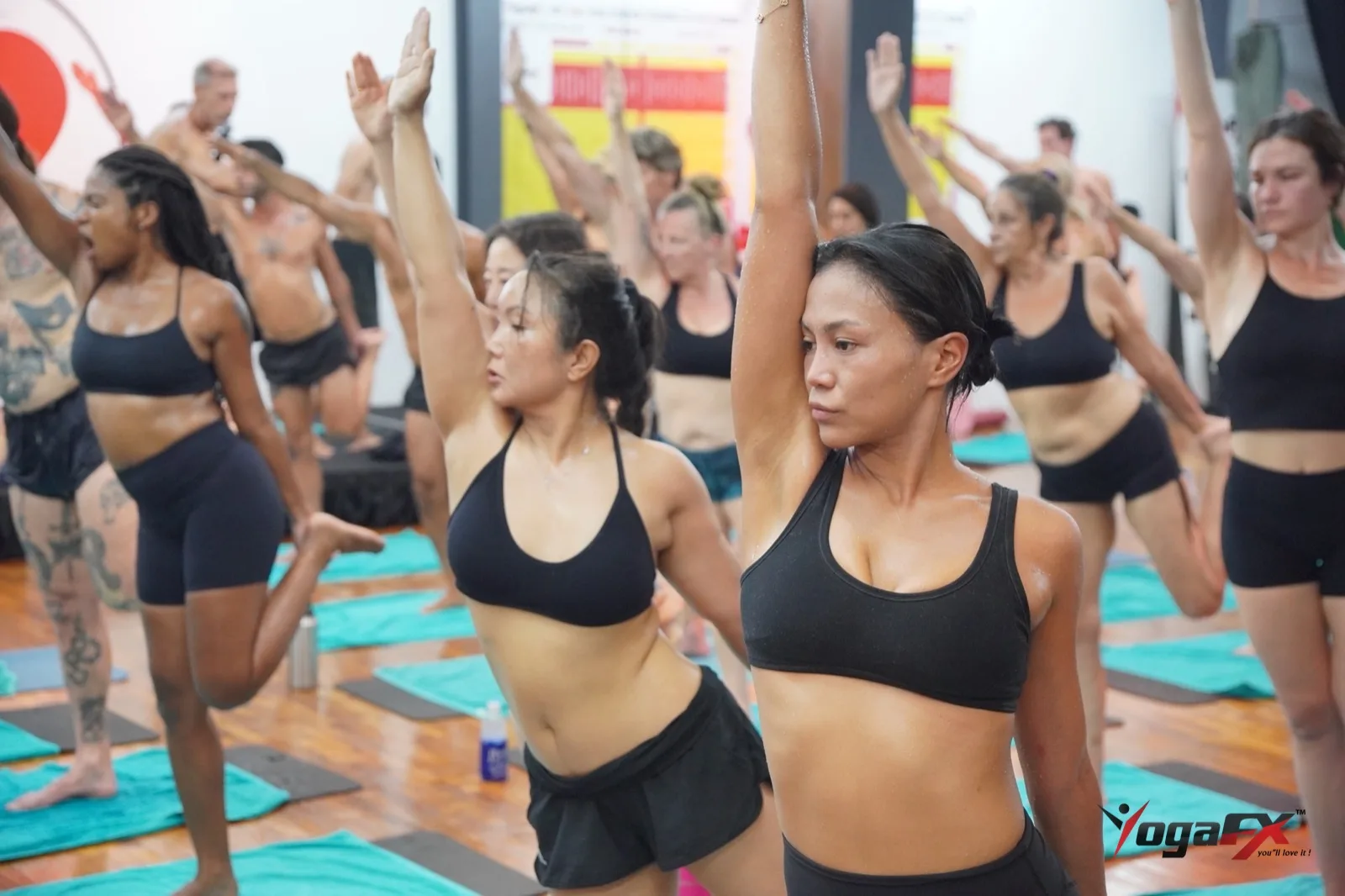
The clearest public description of the event list comes from a government presentation, Yogasana as a Competitive Sport, published by India's Press Information Bureau. It lists seven events for men and women, each with Sub-Junior, Junior and Senior categories:
- Traditional Yogasana. Individual athletes perform compulsory and optional postures from an approved list.
- Artistic Yogasana (single). One athlete performs a choreographed routine of postures.
- Artistic Yogasana (pair). Two athletes perform a routine together.
- Rhythmic Yogasana (pair). A pair performs to music.
- Free Flow or Group Yogasana. A team event.
- Individual All Round Championship. Results from several events combine into one ranking.
- Team Championship. Individual scores add up to a team result.
The same presentation says work had started on an automated scoring system "to introduce objectivity in marking". That detail matters because scoring is the hardest problem in any judged sport. Two humans can watch the same triangle pose and score it differently.
The 2026 world championship used a slightly different list of disciplines in its results. According to Tribune India, medals went out in artistic pair, rhythmic pair, leg balance, hand balance, back bend, twisting body and supine events. So the sport still has more than one rulebook, and the details depend on which federation runs the event.
Age groups in competitive yoga
One thing that surprises newcomers is the age range. Competitive yoga is not only for young gymnasts. The 2026 championship ran six age categories, and the oldest started at 45.
| Category | Age range | Who it suits |
|---|---|---|
| Sub-Junior | 10 to 14 | Children and early teens, often from school programmes |
| Junior | 14 to 18 | Teenage athletes building competition experience |
| Senior | 18 to 28 | Peak-flexibility adults, usually the most competitive field |
| Senior A | 28 to 35 | Experienced practitioners and working teachers |
| Senior B | 35 to 45 | Adults who came to the sport through long practice |
| Senior C | 45 to 55 | Mature athletes, proof that the sport is not only for the young |
Wikipedia adds that in the United States, children's competitions were introduced from age 7. So competitive yoga can start very early and continue into middle age. For most adult students, the realistic entry point is a national or regional event in the older age groups.
Who Runs Competitive Yoga: Federations and Rules
The main governing bodies
There's no single global rulebook, and that's the second thing to understand. Several bodies run competitive yoga, and they grew up separately. The table below shows the main ones and what each one says about itself. Each one set its own rules, so results from one are rarely comparable with another.
| Body | Where it works | What it does |
|---|---|---|
| International Yoga Sports Federation (IYSF) | Global, with federations in over 25 countries | Calls itself the global governing body for yoga asana sport. Its history page lists world championships in London (2014), Pordenone (2016), Beijing (2018), Bengaluru (2022) and Cyberjaya (2025), plus an online edition in 2021. |
| International Federation of Sports Yoga | Montevideo and Pondicherry | Held its first annual championship in 1989. Its events are said to cover all eight limbs of yoga, not only posture. |
| USA Yoga | United States | A nonprofit whose stated mission includes advancing yoga asana as a sport. It trains judges and runs a yearly sport season. |
| Indian national yogasana bodies | India | Backed by government. A 2019 recommendation led to national federation recognition in November 2020, according to the government presentation. |
| Republic of Indonesia Yogasana Sports Federation | Indonesia | The national body for the sport in Indonesia. Mr. Ian Terry holds the title of Master Trainer there, confirmed in June 2026. |
Where the sources disagree
Two of these sources disagree on dates. The IYSF history page says the federation was founded in Lausanne in 2013 and registered in 2014, while Wikipedia says an International Yoga Sport Federation was founded in 2003. Rather than pick a side, we say what each source says. The sport's own paperwork is still catching up with its growth.
If you want the full timeline, from the first formal contests in Calcutta in 1973 to Ahmedabad, see our yoga championship history guide. If you want the 2026 medal table and what Indonesia achieved, read the World Yogasana Championship 2026 report.
Is Competitive Yoga Really Yoga? The Honest Debate
The case against
Not everyone likes competitive yoga, and the criticism is serious, so it deserves a fair hearing. Wikipedia lists several critics. Some call the term an oxymoron. Others say it is a misappropriation, or that yoga is "much more than posturing". A common argument is that yoga teaches you to stop comparing yourself with others, so a scoreboard defeats the point.
The case for
Defenders answer in three ways. First, many traditional Indian pioneers saw physical culture and yoga as one project, and school sport was part of it. Second, asana is a real part of yoga, so testing it is not absurd. Third, the IYSF history page says B.K.S. Iyengar endorsed the organisation and its championship.
Our own view at YogaFX sits in the middle. For example, we see competitive yoga as a sport that borrows yoga's postures, and it should be called what it is. A student who enjoys it gets discipline, a goal and a community. A student who finds it stressful loses nothing by staying in the studio. Neither choice is more spiritual than the other.
There is a practical risk worth naming. When a score is on the line, people push past what their bodies can safely do. Joint injuries in deep backbends and splits are the usual result. Good coaches train range of motion slowly and teach athletes to stop at pain, not at the limit of the mat.
Competitive Yoga and the Bikram 26&2 Postures
The shared lineage
Here is where our own tradition comes in. Bishnu Charan Ghosh, who opened a college of physical education in Calcutta, inspired Bikram Choudhury's yoga, and his students ran the first formal asana contests. So the link between competition and the Bikram sequence isn't a coincidence. It's the same family tree. That is the wider lineage behind every Hot 26&2 class.
Which postures carry over
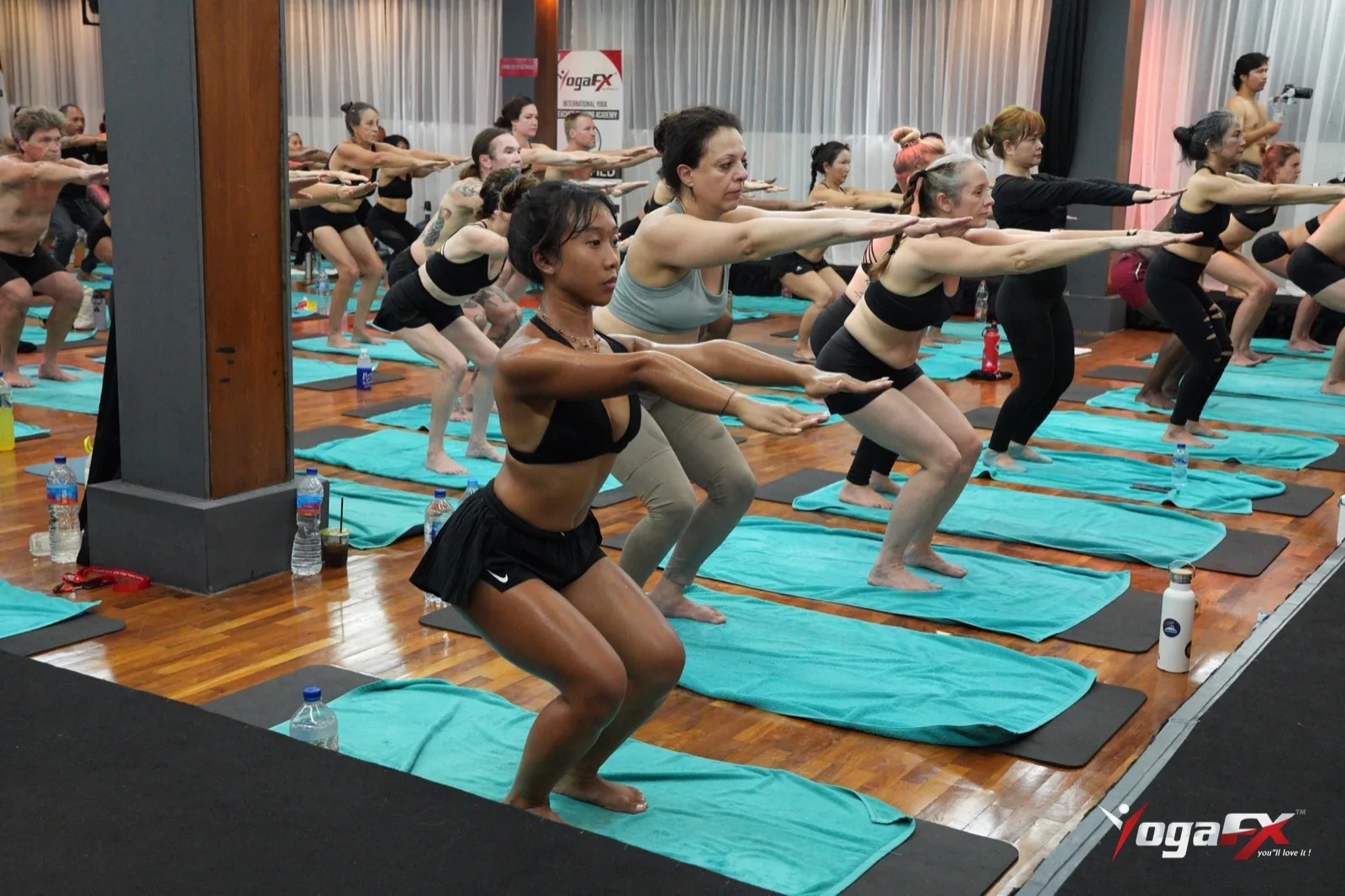
The 26&2 sequence also trains the physical skills that judges score. It asks for balance on one leg, deep backbends, forward folds, spinal twists and long holds, in a fixed order, with exact cues. That is why many competitive athletes use it for conditioning. The table maps each 2026 competition discipline to the closest postures in a Hot 26&2 class.
| Competition discipline | What judges look for | Closest 26&2 postures |
|---|---|---|
| Leg balance | Stillness on one leg, a straight standing leg, a steady gaze | Standing Bow Pulling, Balancing Stick, Standing Head to Knee, Eagle |
| Back bend | Even curve through the spine, open chest, controlled depth | Half Moon with backbend, Camel, Bow, Locust |
| Twisting body | Rotation from the spine, square hips, a tall posture | Spine Twisting, Half Tortoise (as a forward-fold counterpart) |
| Supine | Control and symmetry while lying down | Wind Removing, Sit Up, Cobra (prone counterpart) |
| Hand balance | Arm strength and body line over the hands | No direct match. The sequence has few hand balances, so athletes train these separately |
Note the last row. Hand balances are a real gap. A student who only practises the 26&2 sequence would not be ready for that event without extra training. So we do not claim the sequence is a complete competition programme. It is a strong base for several disciplines and a weak one for others.
The sequence also teaches something competition rewards but rarely teaches: how to stay calm in a hot, crowded room with a script running and your legs shaking. Our guide to Bikram yoga for athletes covers how that crossover works for runners, cyclists and gym-goers, and our guide to hot yoga for runners matches Bikram postures to common running problems.
Is Hot Yoga a Sport?
People often ask whether hot yoga is a sport, and the answer is no, not by itself. A normal hot yoga class has no scoring, no ranking and no opponents. It's a practice. Competitive yoga is the sport, and it uses many of the same postures without the heat or the spoken dialogue.
That said, a hot class is physically serious. A University of Wisconsin study led by Porcari measured a 90-minute Bikram class and reported about 333 calories for women and 460 for men, at around 80 percent of maximum heart rate. Anyone who has finished a full class will not be surprised. It feels like training because it is training.
As a result, the right way to see it is a ladder. At the bottom is a class you enjoy. In the middle is a daily practice that builds real fitness. At the top, for the few who want it, is competitive yoga. You can step off at any rung, and most people do.
What the Research Says About Competition-Style Practice
No study has tested competitive yoga athletes in a heated room, so we cannot claim research proves anything about the sport itself. What research does measure are the qualities judges reward: flexibility, strength, balance and stress control. Here is what the main studies found.
- A 2025 systematic review by Willmott and colleagues pooled 43 studies and 942 participants. It reported benefits from Bikram yoga for flexibility, bone density and well-being.
- A 2013 study by Tracy and Hart on healthy young adults found stronger muscles along the back of the body after regular Bikram practice, reported at about 20 percent. Flexibility and body composition improved too.
- A 2022 paper by Hui and colleagues found that hot yoga reduced state anxiety, which matters for athletes who freeze under pressure.
PubMed and PMC blocked our automated checks when we tried to open these papers, so we name them here instead of linking. We have kept to what the abstracts are known to report. These results show benefits from regular practice. They do not show that any class will make you a champion, and heat is not suitable for everyone.
Please consult a healthcare professional before starting a heated practice or training for competition, especially with a heart condition, pregnancy, low blood pressure or regular medication.
A Master Trainer's View of Competitive Yoga
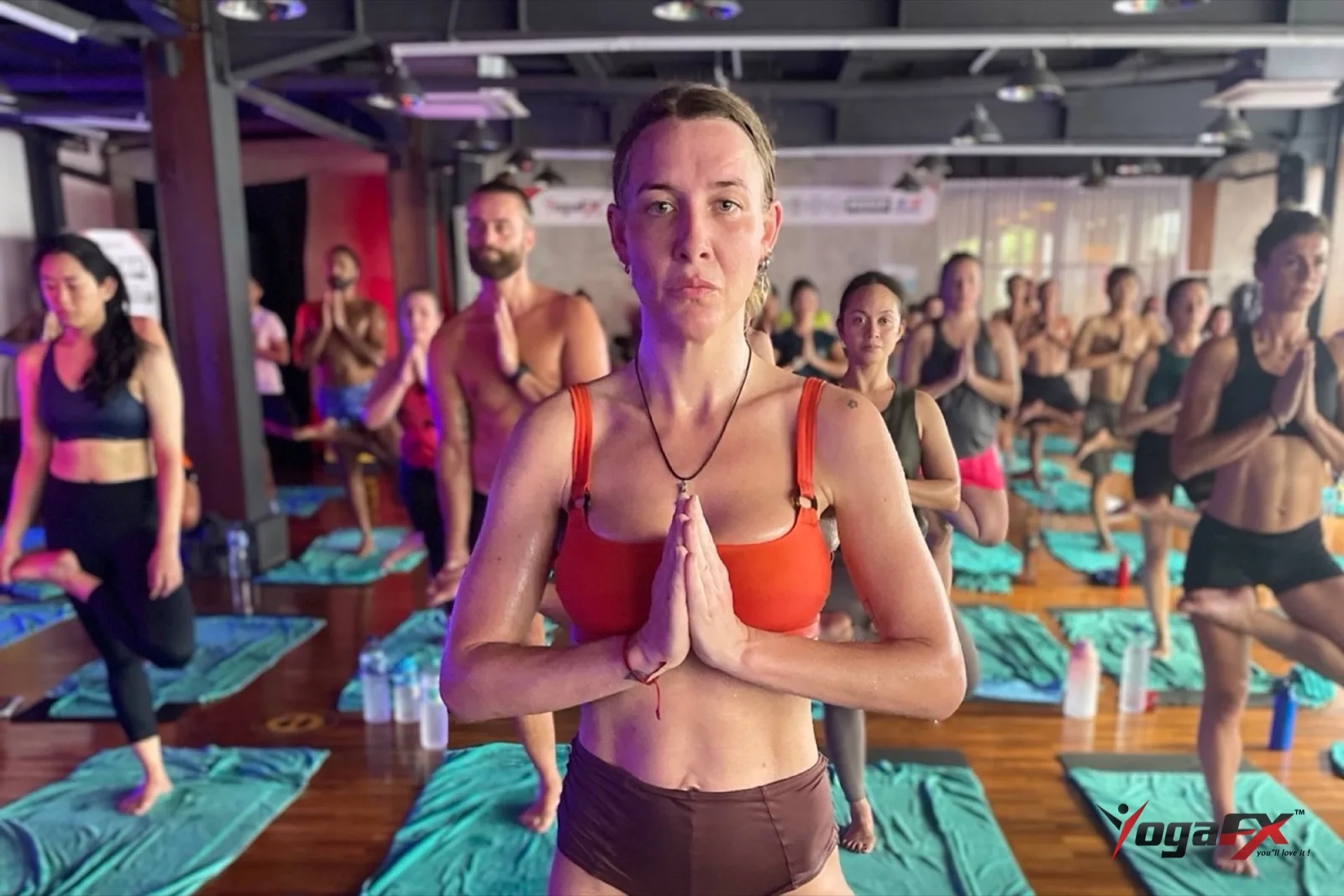
Mr. Ian Terry has taught more than 12,000 hours and spent five years, from 2014 to 2019, training with the founder of the Bikram Hot 26&2 method. He holds the title of Master Trainer with the Republic of Indonesia Yogasana Sports Federation, confirmed in June 2026. Our explainer on what a Master Trainer does sets out the role.
From that seat he watches two worlds. In the studio, students learn to follow exact cues under heat. On the competition floor, athletes do the same thing against a clock. The habit that carries over most is precision under stress, because a posture that falls apart when you are tired will fall apart on stage.
The results back that up. In Ahmedabad, Indonesia won 7 medals: 1 gold, 2 silver and 4 bronze. Two YogaFX graduates were on that team. Ivara Candra Kartika (graduate, 2023) won one gold and one bronze, and Arkan Fauzan Riyanto (graduate, 2022) won two silver and three bronze. Across national, Asian and world events, YogaFX graduates have won 12 medals: 5 gold, 3 silver and 4 bronze.
Not every student wants to compete, and that is fine. Many come for a stronger practice or a teaching career. Here is how some of them describe the experience in their own words.
Mr. Ian's YogaFX program was the most impactful and unforgettable experience of my life.
Greta, Yoga Alliance review, 2026
intense but completely worth it, and you get to meet with some incredible people from all over the world.
Samantha, Yoga Alliance review, 2025
We all had to work and learn hard, it was so rewarding.
Celia, Google review, 2025
If that sounds like you, the six-day hybrid MasterClass is the route into teaching. Our guide to Bikram yoga teacher training dates, cost and formats sets out how it works, and the next intake checks in on Sunday 24 January 2027.
How to Start in Competitive Yoga
You don't need to be a gymnast. You do need patience, because the first year is mostly about building a safe range of motion. This is the path we suggest to students who ask.
- Build a base practice. Practise three to five times a week for at least six months before you think about a scoreboard.
- Find your national body. Search for the yogasana or yoga sport federation in your country. Rules, age groups and posture lists differ from one federation to the next.
- Get the posture list. Federations publish compulsory and optional postures. Learn the list and practise each one with a teacher watching.
- Train with a coach or judge. Judges notice small errors that you cannot see in a mirror. USA Yoga, for example, runs judge training for certified instructors.
- Start local. Enter a regional event in your age group before aiming at a national one.
- Protect your body. Warm up properly, stop at pain and rest between sessions.
If you are a teacher, learning the competition rules also makes you a better coach for students who want to try. That is one reason we encourage graduates to attend federation events.
FAQ
What is competitive yoga?
Competitive yoga is the performance of yoga postures in sporting competitions. Athletes perform set or chosen postures and judges score them on alignment, balance, stability and control. It is also called yogasana sport. Competitions run from school level in India to world championships, and the rules vary by federation.
How do you compete in yoga?
Join your national yoga or yogasana sport federation, learn its posture list and rules, and enter an event in your age group. Train with a coach who knows the scoring. Start at a regional event before aiming higher. Most federations also run judge and coach courses for certified teachers.
Is competitive yoga bad for you?
It can be healthy or harmful depending on how you train. Strength, balance and focus all improve with practice. The risk comes from forcing deep backbends and splits for a score. Warm up, train range of motion slowly, stop at pain and see a healthcare professional if you have a condition.
Is hot yoga a sport?
A hot yoga class is a practice, not a sport, because nobody scores or ranks you. Competitive yoga is the sport, and it uses many similar postures without the heated room or the spoken dialogue. A 90-minute hot class is physically demanding, but it has no opponents or medals.
Is competitive yoga in the Olympics?
Not at present. Yoga is not an Olympic sport today, although federations have said they hope it will be recognised one day. That is an ambition, not a decision. Olympic inclusion depends on many bodies and nothing is confirmed, so treat any date you read with caution.
Still have questions? Message Mr. Ian and the YogaFX team on WhatsApp and we will answer them personally. We can explain how the training works, which dates are open, and whether the six-day MasterClass suits your goals, whether you want to compete or simply teach.